
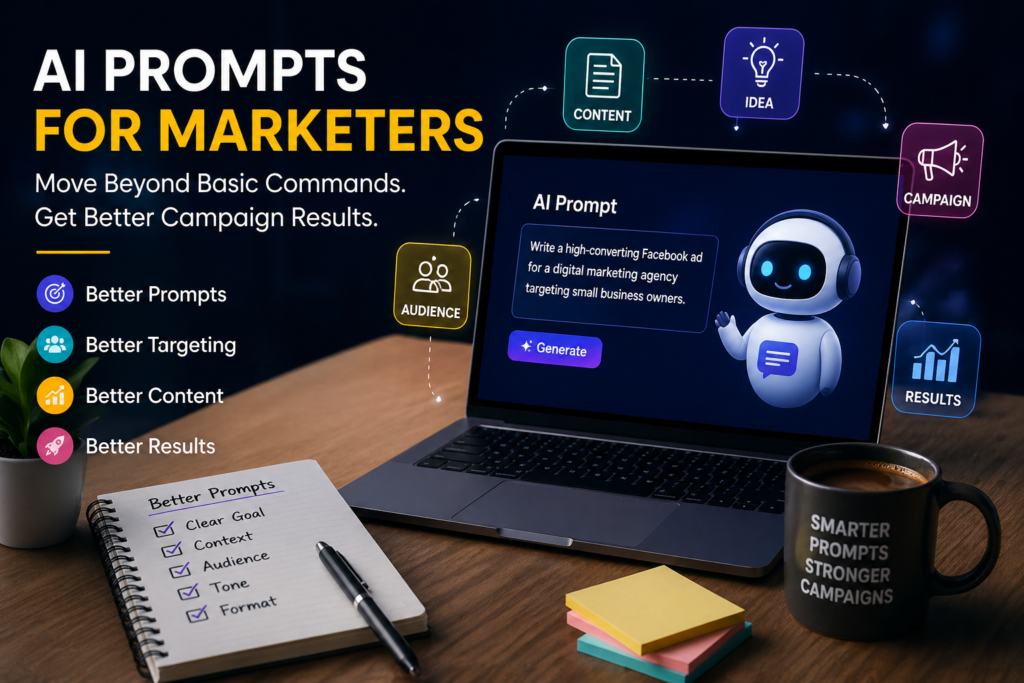
AI prompts for marketers are becoming essential in modern digital marketing as businesses increasingly rely on tools like ChatGPT for content creation, campaign strategy, and audience engagement. However, many still rely on basic commands such as “write an ad copy” or “create a social media post.” While these prompts may generate content quickly, the results are often generic and fail to deliver strong campaign performance.
To achieve better outcomes, marketers must move beyond simple instructions and learn how to create advanced AI prompts. Well-structured prompts provide clarity, direction, and context, allowing AI tools to generate more targeted, engaging, and conversion-focused content.
Why AI Prompts for Marketers Matter?
AI Prompts for Marketers play a crucial role in improving the quality and effectiveness of digital marketing campaigns. Instead of relying on basic instructions, well-structured prompts help generate more targeted and relevant content that aligns with business goals. This leads to better engagement, stronger messaging, and improved conversion rates.
One of the biggest advantages of using advanced prompts is the ability to guide tools like ChatGPT with clear context. When marketers define the audience, objective, and tone, the output becomes more personalized and impactful. For example, a prompt that includes details about customer pain points and desired outcomes will produce content that resonates better with the target audience.
Additionally, AI Prompts for Marketers help save time while maintaining quality. Instead of rewriting generic outputs, marketers can generate high-performing ad copy, social media posts, and email campaigns in fewer iterations. This efficiency allows businesses to focus more on strategy and creativity rather than repetitive tasks.
Another important benefit is consistency. By using structured prompts, marketers can maintain a consistent brand voice across different platforms and campaigns. This is essential for building trust and recognition in competitive markets.
Overall, mastering AI Prompts for Marketers is no longer optional. It is a key skill that enables marketers to maximize the potential of AI tools and achieve better campaign results.
To understand how AI fits into real-world marketing strategies, learning from experienced digital marketing professionals can be helpful.
Understanding Basic vs Advanced Prompts
A basic prompt lacks detail and purpose. For example:
“Write a Facebook ad for a clothing brand.”
This type of request does not define the audience, tone, or goal, resulting in average-quality output.
An advanced prompt, on the other hand, includes clear instructions:
“Act as a digital marketing expert. Create a high-converting Facebook ad for a clothing brand targeting young adults aged 18–30. Focus on affordability and trendy fashion, and include a strong call-to-action.”
The second prompt produces more relevant and effective content because it provides context and direction.
Why Advanced AI Prompts Matter
Using advanced prompts can significantly improve marketing performance. First, they enhance content quality by making outputs more specific and engaging. Second, they improve audience targeting by aligning the message with user needs and preferences. Finally, they increase conversion potential by guiding the AI to include persuasive elements such as benefits, urgency, and strong calls-to-action.
In a competitive environment, better prompts lead to better campaign results.
Key Elements of High-Performing AI Prompts
To create effective prompts, marketers should include five essential elements.
1. Role Definition: Assign a role to the AI, such as “act as a performance marketer,” to influence tone and expertise.
2. Context: Provide background details about the product, industry, and audience.
3. Objective: Clearly state the goal, whether it is generating leads, increasing engagement, or driving sales.
4. Constraints: Define limits such as word count, tone, or platform requirements.
5. Output Format: Specify how the response should be structured, such as bullet points, ad copy, or an email sequence.
Including these elements ensures the AI generates useful and actionable outputs.
7 Powerful Ways to Improve AI Prompts for Marketers
Combine AI output with human creativity
Define a clear role for the AI
Provide detailed context about your audience
Set a specific campaign objective
Add constraints like tone and format
Use examples to guide output
Examples:- Advanced AI Prompts for Marketers
Here are practical examples of Advanced AI Prompts for Marketers for better marketing campaigns.
For ad copy:
“Act as a Meta ads expert. Write three high-converting ad copies for a skincare brand targeting women aged 20–35 dealing with acne. Highlight emotional pain points and include a compelling call-to-action.”
For audience research:
“Analyze the target audience for a fitness brand and list their top ten pain points, motivations, and buying triggers.”
For email marketing:
“Create a five-email product launch sequence that builds excitement and increases urgency with each message.”
For social media:
“Generate seven Instagram post ideas for a graphic design business focused on attracting new clients and building brand authority.”
These examples demonstrate how structured prompts produce better outputs.
Common Mistakes to Avoid
Marketers often make avoidable mistakes when using AI tools. One common issue is using vague prompts without clear instructions. Another mistake is ignoring the importance of audience details, which leads to irrelevant content. Some marketers also fail to edit or refine AI-generated output, reducing its effectiveness. Over-reliance on automation without human input can further limit results.
Avoiding these mistakes can significantly improve the quality of AI-generated content.
Tips to Improve Your Prompt Strategy
To get the best results, marketers should continuously refine their approach. Testing different prompt variations can help identify what works best. Adding real-world data and examples improves accuracy and relevance. Reviewing and editing outputs ensures higher quality. Most importantly, combining AI capabilities with human creativity leads to stronger and more impactful campaigns.
AI tools like Chat GPT offer powerful opportunities for marketers, but success depends on how effectively they are used. Moving beyond basic commands and adopting structured, advanced prompts allows marketers to create high-quality, targeted, and conversion-driven content.
By mastering AI prompts, marketers can improve campaign performance, save time, and gain a competitive edge in the evolving digital marketing landscape. AI Prompts for Marketers are becoming essential for creating high-performing campaigns. For marketing and digital content related inquiries, visit our Contact Us page.
Table of Contents
- Introduction
- Why AI Prompts for Marketers Matter
- What Are Basic vs Advanced Prompts
- Key Elements of High-Performing AI Prompts
- 7 Powerful Ways to Improve AI Prompts for Marketers
- Advanced AI Prompt Examples
- Common Mistakes to Avoid
- Tips to Improve Your Prompt Strategy
- Conclusion
Blog created and submitted by Aditya Jain.
