
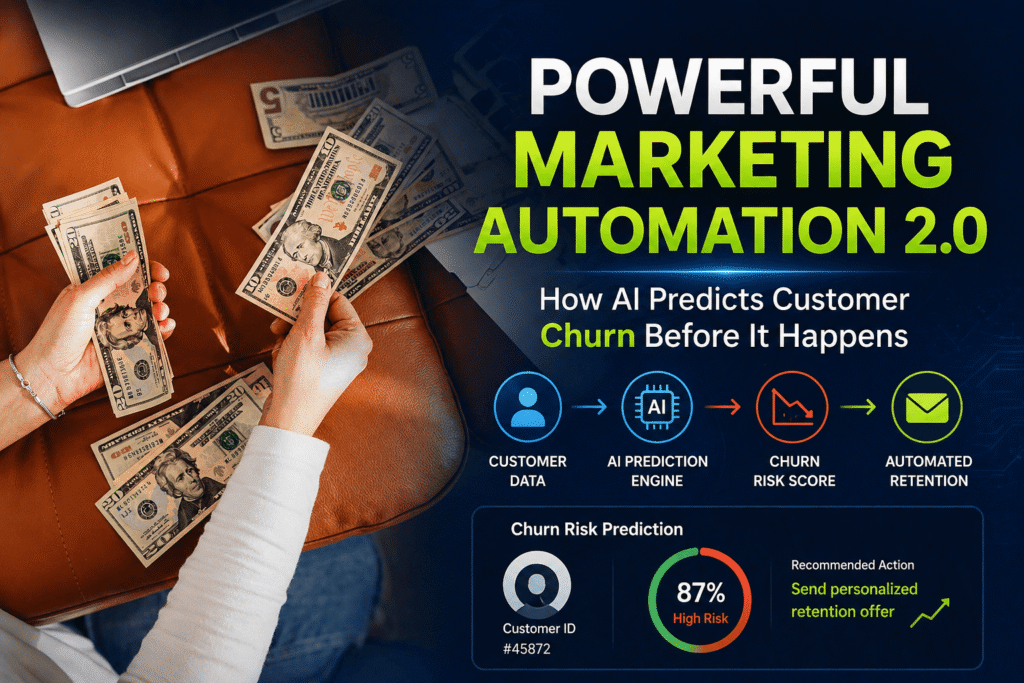
In today’s fast-moving world of digital marketing, keeping your customers is just as important as getting new ones. Many businesses spend heavily on ads and lead generation but lose customers without even realizing why. This is where Marketing Automation 2.0 comes in—powered by AI to predict customer churn before it happens.
Let’s break it down in a simple and practical way.
What is Customer Churn in Digital Marketing?
Customer churn means when people stop buying from you or stop using your service. In digital marketing, churn is a silent killer.
You might think everything is working fine, but behind the scenes, customers are losing interest.
Some common reasons:
- Poor customer experience
- Lack of engagement
- Better competitor offers
- Irrelevant content
The problem? Most businesses notice churn after it happens.
What is Marketing Automation 2.0?
Traditional automation in digital marketing focuses on scheduled emails, basic funnels, and simple triggers.
But Marketing Automation 2.0 is smarter.
It uses AI and data to:
- Track user behavior
- Analyze patterns
- Predict future actions
Instead of reacting late, you act before the customer leaves.
How AI Predicts Customer Churn
AI works like a smart assistant that never sleeps. It studies your customers deeply.
Here’s how it works in digital marketing:
1. Behavioral Tracking
AI tracks what users do on your website, emails, or app.
For example:
- Are they opening emails less often?
- Are they visiting less frequently?
- Did they stop adding items to cart?
These are early warning signs.
2. Pattern Recognition
AI compares current behavior with past data.
If similar users left before, AI flags these users as “at risk.”
This is where digital marketing becomes predictive, not reactive.
3. Predictive Scoring
Each user gets a “churn score.”
Higher score = higher risk of leaving.
This helps marketers focus on the right audience instead of guessing.
Why This is Powerful for Your Business
Using AI in digital marketing gives you a major advantage.
Save Money
It’s cheaper to retain a customer than acquire a new one.
AI helps you protect your existing revenue.
Personalized Experience
Instead of sending generic messages, you can send:
- Special offers
- Personalized emails
- Re-engagement campaigns
This makes customers feel valued.
Better Decision Making
Better Decision Making
No more guesswork.
AI turns raw data into clear insights, so your digital marketing decisions are based on facts, not assumptions. It helps you understand what’s working, what’s not, and where to focus your efforts.
With real-time data and predictions, your digital marketing strategy becomes smarter, faster, and more effective—leading to better results with less wasted effort.
Real Example (Simple Understanding)
Imagine you run an online clothing store.
A customer who used to shop every month suddenly stops browsing.
AI detects:
- Reduced visits
- No recent purchases
- Ignored emails
Now your digital marketing system can:
- Send a personalized discount
- Show ads with their favorite styles
- Offer a limited-time deal
Result? You win back the customer before they leave forever.
Best AI Tools for Marketing Automation
Some popular tools used in digital marketing include:
- HubSpot
- ActiveCampaign
- Salesforce Marketing Cloud
- Klaviyo
These tools combine automation with AI insights.
How to Start Using This Strategy
You don’t need a huge budget to start improving your digital marketing with AI.
Start small:
- Track user behavior (Google Analytics, CRM tools)
- Segment your audience
- Automate email responses
- Use AI-powered tools for insights
Then gradually upgrade to advanced automation.
Final Thoughts
The future of digital marketing is not just automation—it’s intelligent automation.
Marketing Automation 2.0 allows you to:
- Understand your customers deeply
- Predict their actions
- Take action before losing them
If you want to grow your business, increase profits, and build long-term relationships, this approach is not optional anymore—it’s essential.
Start using AI in your digital marketing today, and turn potential losses into long-term loyal customers.
This blog is created n submitted by Richneet Singh
