
Everything a first-timer needs to earn high-quality SEO backlinks — without expensive agencies or black-hat tricks.
You Can’t Rank Without Links — But Nobody Told You How to Get Them
Backlink building for beginners is one of the most Googled phrases in the entire digital marketing space — and for good reason. Every SEO guide eventually tells you to “get more backlinks,” yet very few actually explain how a newcomer is supposed to do that without a team, a big budget, or years of industry connections. This comprehensive guide to backlink
building for beginners covers everything you need to know.
This guide changes that. Whether you’re a small business owner trying to outrank a competitor, a blogger looking to grow organic traffic, or an aspiring digital marketer building foundational skills — this is the practical, jargon-free walkthrough you’ve been looking for. Whether you’re new to SEO, this backlink-building walkthrough for beginners is designed for you.
By the end, you’ll understand exactly what backlinks are, why Google cares about them so deeply, and how to start earning them today using free and low-cost strategies that actually work in 2026. By the end of this backlink building for beginners guide, you’ll have a complete action plan ready.
According to Backlinko’s analysis of over one billion pages, the number one result in Google search has, on average, 3.8× more backlinks than pages ranking in positions two through ten.
Section 01
What Are Backlinks?
A backlink (also called an inbound link or incoming link) is simply a hyperlink on someone else’s website that points to a page on your website. When a food blogger writes a recipe roundup and links to your cooking tool, that’s a backlink to your site. Understanding backlinks is the first step in backlink building for beginners. This is the foundation of every
backlink building for beginners strategy that actually works.
Think of backlinks as votes of confidence on the internet. When reputable sites link to yours, they’re effectively telling Google: “This page is worth reading.”
Dofollow vs. Nofollow Links
Not all backlinks are created equal. A dofollow link passes “link equity” (often called PageRank) to your site and directly boosts your authority. A nofollow link includes an HTML tag that tells search engines not to count it as a formal vote — but it can still drive referral traffic and add link diversity to your profile.
“A backlink is the web’s way of saying: this page deserves to be found.”
Section 02
Why Backlinks Matter for SEO
Google’s original algorithm — PageRank — was built on a single insight: a page linked to by many high-quality pages is probably a high-quality page itself. Two decades later, that logic still holds. Backlinks remain one of the top three confirmed ranking factors in Google’s algorithm and a core part of every successful SEO strategy.. This is exactly why backlink building for beginners should be your top SEO priority in 2026.
Here’s what a strong backlink profile actually does for you:
- Higher rankings — Quality links push your pages up in search results.
- Faster indexing — Googlebot discovers new pages by following links; links get you crawled sooner.
- Domain Authority (DA) — The stronger your backlink profile, the more your entire domain benefits — even pages that have no direct links.
- Referral traffic — Real people click those links. A single placement on a high-traffic website can send hundreds of qualified visitors your way.
- Brand credibility — Being cited by respected sources builds trust with both search engines and readers.
- Higher rankings — Quality links push your pages up in search results.
- Faster indexing — Googlebot discovers new pages by following links; links get you crawled sooner.
- Domain Authority (DA) — The stronger your backlink profile, the more your entire domain benefits — even pages that have no direct links.
- Referral traffic — Real people click those links. A single placement on a high-traffic website can send hundreds of qualified visitors your way.
- Brand credibility — Being cited by respected sources builds trust with both search engines and readers.
Section 03
Backlink Building for Beginners: The Step-by-Step Process
This is the heart of your beginner backlink strategy. Follow these steps in order and you’ll have a repeatable system within a few weeks.
1. Audit Your Current Backlink Profile
Before building new links, understand what you already have. Use Google Search Console (free) to see who’s linking to you. Look for toxic or spammy links that could be hurting your rankings — and disavow them if necessary. This gives you a clean baseline. Auditing your profile is Step 1 in any backlink building for beginners checklist.
Real-World Example
Imagine you run a small home décor e-commerce store called “NestCraft.” You open Google Search Console and find 120 backlinks. Great — until you notice 40 of them come from a gambling site, a foreign pharmacy, and an unrelated adult directory.
What Google sees: “NestCraft is being linked to by shady websites. Maybe NestCraft is shady too.” Your rankings quietly drop.
What you do: Create a disavow file, submit it to Google, and remove those toxic links. Now your profile is clean — and Google trusts you again. ✅
✓ Clean Baseline Achieved — Ready to Build
2. Create “Link-Worthy” Content First
This is the step most beginners skip — and it’s why their outreach fails. You need something worth linking to. Think original research, comprehensive guides, free tools, data visualizations, or strong opinion pieces. Content that provides unique value earns links naturally over time. Creating great content is the most important backlink building for beginners tactic available.
Real-World Example
You run a digital marketing blog. Instead of writing another generic “10 SEO Tips” post, you spend a weekend surveying 200 small business owners and publish:
“2026 Small Business SEO Survey: What 200 Owners Wish They Knew Before Starting”
Within 3 months, 14 other marketing blogs link to your survey because it has original data nobody else has. You didn’t need to ask — the content did the work.
| Content Type | Link-Earning Power | Effort Level |
|---|---|---|
| Original Research / Survey | ⭐⭐⭐⭐⭐ Very High | Medium |
| Ultimate Guide (5,000+ words) | ⭐⭐⭐⭐ High | High |
| Free Tool / Calculator | ⭐⭐⭐⭐⭐ Very High | High |
| Infographic with Data | ⭐⭐⭐ Good | Medium |
| Generic “Tips” Blog Post | ⭐ Low | Low |
3. Identify Your Competitors’ Backlinks
Use Ahrefs, Semrush, or the free Ubersuggest to analyze which sites are linking to your top competitors. If a site is willing to link to them, there’s a real chance they’ll link to you too — especially if your content is stronger.
Real-World Example — Step by Step
You sell handmade yoga mats online. Your competitor is “ZenMats.com.” Here’s exactly what you do:
Step A: Open Ubersuggest (free) → enter “zenmats.com” → click “Backlinks.”
Step B: You see that YogaJournal.com, HealthlineWellness.com, and FitnessBloggers.net all link to ZenMats.
Step C: You think — “These 3 sites clearly cover yoga products. If they linked to ZenMats, they might link to me too — especially if my content is better.”
Step D: You add all 3 to your outreach list and prepare a personalized pitch for each one.
| Site Found | Why They Linked to Competitor | Your Angle |
|---|---|---|
| YogaJournal.com | Product roundup article | Pitch your mat for their next roundup |
| HealthlineWellness.com | Eco-friendly products guide | Highlight your sustainable materials |
| FitnessBloggers.net | Guest post by competitor | Pitch your own guest post idea |
✓ You now have a warm, targeted outreach list
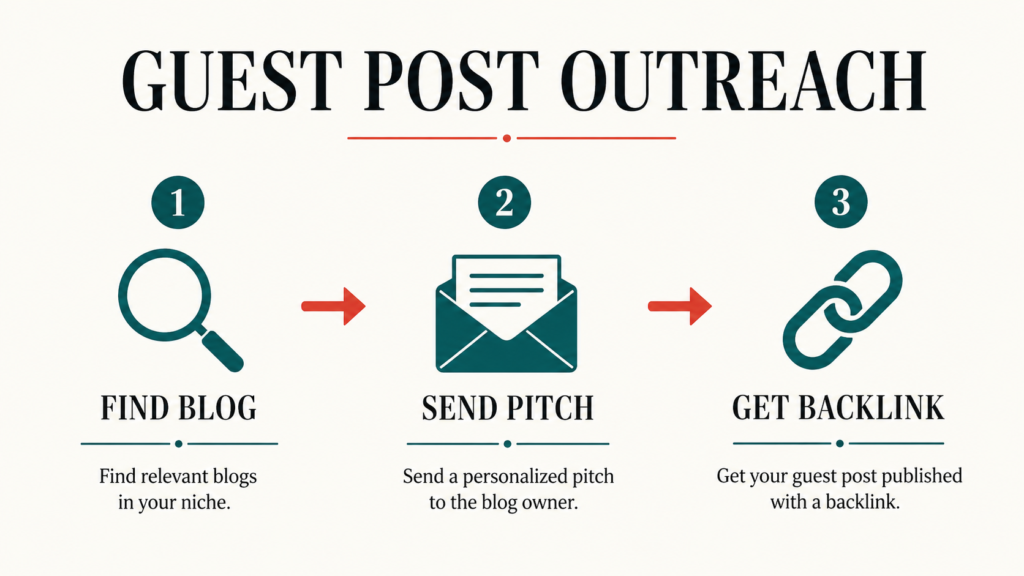
4. Start With Guest Blogging
Guest posting on relevant industry blogs remains one of the highest-return link-building tactics available to beginners. Search Google for “your niche + write for us” or “your niche + guest post guidelines.” Pitch concise, value-packed article ideas — don’t pitch yourself, pitch the value to their audience. Guest blogging is the most recommended backlink building for beginners strategy online.
Real-World Example + Outreach Email Template
You run a personal finance blog. You find that “MoneySmartDaily.com” accepts guest posts. Here’s a pitch that actually works: Guest Post Pitch Email Template
Subject: Guest Post Idea for MoneySmartDaily — “5 Budgeting Mistakes New Grads Make” Hi [Editor’s Name], I’ve been a regular reader of MoneySmartDaily — your recent piece on emergency funds was genuinely helpful. I’d love to contribute a guest post for your audience. My proposed title: “5 Budgeting Mistakes Most New Graduates Make in Their First Year” I’m a certified financial planner with 4 years of experience. I’ve already outlined the piece and can deliver a polished 1,200-word draft within 5 days. Would this be a good fit for your readers? Best, [Your Name] [yourwebsite.com]
Why this works: You opened with a compliment (genuine, not flattery), pitched the reader’s benefit not your credentials, gave a concrete title, and set a clear deadline. That’s professionalism — and it converts.
✓ 1 accepted guest post = 1 high-quality dofollow backlink
5. Use the Broken Link Building Method
Find pages in your niche that contain broken outbound links (links to pages that no longer exist). Use the free Check My Links Chrome extension or Ahrefs’ Site Explorer. Then contact the site owner, politely flag the broken link, and suggest your relevant page as a replacement. You’re solving their problem — they’re motivated to help.
Real-World Example + Outreach Email Template
You have a cooking website. While browsing a popular food blog’s “Best Baking Resources” page, you spot a broken link using the Check My Links extension — it was pointing to a baking guide that no longer exists.
You have a similar guide on your site: “The Complete Beginner’s Guide to Sourdough Baking.”
This is your moment. You email the blog owner and offer your page as a replacement.
✉ Broken Link Outreach Email Template
Subject: Broken Link on Your “Best Baking Resources” Page Hi [Name], I was browsing your “Best Baking Resources” page today and noticed one of the links appears to be broken: → “Ultimate Sourdough Guide” (currently returning a 404 error) I actually have a similar resource that your readers might find helpful: “The Complete Beginner’s Guide to Sourdough Baking” → [yourwebsite.com/sourdough-guide] Thought it might be a worthy replacement — happy either way! Cheers, [Your Name]
✓ You solve their problem — they reward you with a link
6. Get Listed in Quality Directories
Industry-specific and local directories are an easy, legitimate source of early backlinks for small businesses. Examples: Yelp, Clutch, G2, Crunchbase, and niche-specific directories. Avoid mass-submission spammy directories — focus on relevant, curated ones only. Directory listings give backlink building for beginners their first quick wins.
Real-World Example
You run a freelance web design agency. Within one afternoon, you register on 4 directories — and earn 4 legitimate backlinks instantly:
| Directory | Best For | Link Type | Time to Set Up |
|---|---|---|---|
| Clutch.co | Agencies & freelancers | Dofollow | 20 min |
| G2.com | Software & SaaS | Dofollow | 15 min |
| Crunchbase | Startups & businesses | Nofollow | 10 min |
| DesignRush | Design & creative agencies | Dofollow | 15 min |
Warning: Do NOT use services that promise “500 directory submissions for $10.” Those are spam farms that will get your site penalized. Stick to manually verified, niche-relevant directories only.
⚠ Quality over Quantity — Always
7. Build HARO & PR Links
Help a Reporter Out (HARO) — now operating as Connectively — sends daily emails from journalists seeking expert quotes. Respond to relevant queries with concise, quotable insights and many reporters will link back to your website. It’s free, and a single good placement in Forbes or Inc. can transform your domain authority.
Real-World Example — HARO in Action
You own a small fitness equipment brand. One morning, a HARO email arrives from a Forbes journalist writing: “Looking for fitness experts to comment on home workout trends in 2026.”✉ Strong HARO Response Template
HARO Response — Forbes Query: Home Workout Trends 2026 Hi [Reporter’s Name], I’m [Your Name], founder of [Brand] and a certified personal trainer with 6 years experience. Here’s my expert take on the biggest home workout trend of 2026: “The biggest shift we’re seeing is micro-workouts — 10-minute sessions spread throughout the day. Our sales data shows resistance band sets are up 140% compared to 2024, because they’re compact, affordable, and effective for these short bursts of movement.” Happy to provide more data or a follow-up quote if needed. [Your Name] | [yourwebsite.com] | [Phone]
Result: The Forbes reporter uses your quote, publishes the article, and links back to your website. One Forbes backlink can have a Domain Rating of 90+ — the equivalent of hundreds of ordinary links.
✓ 1 PR Link from Forbes = Massive SEO Boost
8. Track, Measure, and Iterate
Use Google Search Console and Ahrefs/Semrush to monitor new backlinks monthly. Track which tactics are generating the most links and double down on those. Drop tactics that cost time but deliver nothing. This turns link building from guesswork into a system. Tracking results completes your backlink building for beginners system perfectly.
Real-World Example — Monthly Tracking Sheet
After 60 days of consistent effort, here’s what your tracking spreadsheet might look like — and what decisions it drives:
| Tactic Used | Time Spent | Links Earned | Decision |
|---|---|---|---|
| Guest Blogging | 8 hours | 6 links | ✅ Double down |
| HARO / PR Pitching | 3 hours | 2 links (high-authority) | ✅ Keep going |
| Broken Link Building | 5 hours | 1 link | 🔄 Refine approach |
| Directory Listings | 2 hours | 5 links | ✅ Complete once |
| Random Blog Comments | 4 hours | 0 links | ❌ Stop immediately |
Key insight: Blog comments wasted 4 hours for zero return. Guest blogging took 8 hours but returned 6 links. The data makes the decision obvious — no guesswork needed.
✓ Data-driven = Faster Results, Less Wasted Time
Section 04
Common Mistakes to Avoid in Your Backlink Strategy
Most beginners struggle not because the tactics are hard, but because they make one of these avoidable errors. These are the most common backlink building for beginners mistakes to avoid in 2026.
- Buying bulk links from link farms. Google’s Penguin algorithm was specifically built to detect and penalize unnatural link patterns. One bad batch can tank your domain for months. Buying links is the #1 mistake in backlink building for beginners that ruins entire domains.
- Over-optimizing anchor text. If 70% of your backlinks use the exact keyword “best digital marketing agency,” that’s a red flag. Natural link profiles have varied, branded, and generic anchor text.
- Ignoring link relevance. A backlink from a fishing blog to your software company is nearly worthless. Relevance matters almost as much as authority.
- Mass emailing generic outreach. “Hi, I’d love a link” Emails get deleted. Personalized outreach with a clear value proposition converts at dramatically higher rates. Smart backlink building for beginners always focuses on personalized outreach only.
- Not tracking your results. Without measurement, you can’t tell what’s working. Set up a simple spreadsheet and check your link profile monthly at minimum.
- Chasing quantity over quality. Ten links from authoritative, relevant sites will outperform 200 links from low-quality directories every single time.
Section 05
Best Tools for Backlink Research
You don’t need to spend a fortune on SEO tools when you’re starting out. Here’s a practical toolkit for every budget. These tools make backlink building for beginners much easier and more data-driven.
The essential starting point. See your current backlinks directly from Google, monitor index coverage, and spot penalties.
The industry’s most comprehensive backlink database. Excellent for competitor analysis, link prospecting, and DR tracking.
All-in-one SEO suite with strong backlink analytics. Free tier gives limited daily searches — enough for beginners.
Neil Patel’s beginner-friendly tool. Generous free plan for backlink checks, keyword research, and site audits.
Clean UI and reliable domain authority metrics. Free for 10 queries/month — ideal for quick competitive checks.
Finds contact emails for your outreach prospects in seconds. Free for 25 searches/month — a must for personalized outreach.
Start with Google Search Console + Ubersuggest for zero cost. Once you’re generating consistent organic traffic and need deeper competitive intelligence, upgrade to Ahrefs or Semrush.
Section 06
Expert Tips for Beginners
These are the high-leverage moves that separate beginners who get results from those who quit after a month. These expert tips will take your backlink building for beginners efforts to the next level.
Target low-DR competitors first
Competing with Forbes is a losing battle. Find niche sites with Domain Rating 20–40 — they’re far more likely to link back.
Write better content than what exists
Find a top-ranking article in your niche and create a version that’s more up-to-date, more detailed, or covers a missing angle.
Build relationships, not just links
Engage with bloggers and editors on social media before pitching. Warm outreach converts at 3–5× the rate of cold emails.
Repurpose content into linkable assets
Turn a blog post into a free checklist, infographic, or template. New formats attract links from audiences who wouldn’t engage with prose.
Publish original data or surveys
Original statistics are one of the most-linked content types on the web. Even a small survey of 100 customers can generate dozens of citations.
Be consistent, not frantic
Five quality outreach emails per week beats 100 mass-blasted templates. Slow, steady, and personal wins every time.
Section 07
Conclusion: Your Backlink Building Journey Starts Today
If there’s one truth about SEO, it’s this: links are trust, and trust is rankings. Backlink building for beginners doesn’t have to be complicated. It starts with creating content worth linking to, identifying the right opportunities, and reaching out to real people in your niche with genuine value to offer.
You now have a complete roadmap: you know what backlinks are, why they move the needle, which tools to use, which mistakes to sidestep, and eight concrete tactics to start today. The only thing left is to take the first step.
Start small. Audit your current links this week. Write one piece of link-worthy content. Send ten personalized outreach emails. Track what happens. Then do it again — and again. Over months, that compound effort turns into rankings, traffic, and real business growth.
Frequently Asked Questions
How long does backlink building take to show results?
Most SEO professionals see measurable movement in rankings within 3–6 months of consistent link-building activity. Google needs time to crawl, index, and evaluate new links. The more authoritative the sites linking to you, the faster you may see results — but patience is essential. Treat it as a long-term investment, not a quick fix.
What is a good number of backlinks for a new website?
There’s no universal benchmark, but for a brand-new site, even 10–20 high-quality backlinks from relevant, authoritative domains can create a noticeable impact. Focus on quality over quantity — one link from a respected industry publication is worth far more than 100 links from obscure, unrelated blogs.
Is it safe to buy backlinks for SEO?
No. Buying links violates Google’s Webmaster Guidelines and can result in a manual penalty — which can remove your site from search results entirely. The risk is not worth the short-term gain. Focus on earned links through legitimate strategies like content marketing, guest posting, and digital PR instead.
What types of content attract the most backlinks?
Original research and data, comprehensive “ultimate guide” style posts, free tools and calculators, infographics, expert roundups, and controversial or counter-intuitive opinion pieces consistently generate the most organic backlinks. Content that provides a genuinely unique perspective or resource tends to earn links naturally over time.
What is the difference between white-hat and black-hat link building?
White-hat link building follows Google’s guidelines — earning links through quality content, outreach, and digital PR. Black-hat link building uses manipulative tactics like link farms, paid links, and private blog networks (PBNs) to artificially inflate rankings. White-hat tactics are slower but sustainable; black-hat tactics risk Google penalties that can permanently damage your site’s visibility.
Blog created and submitted by Himanshi Kochar
