
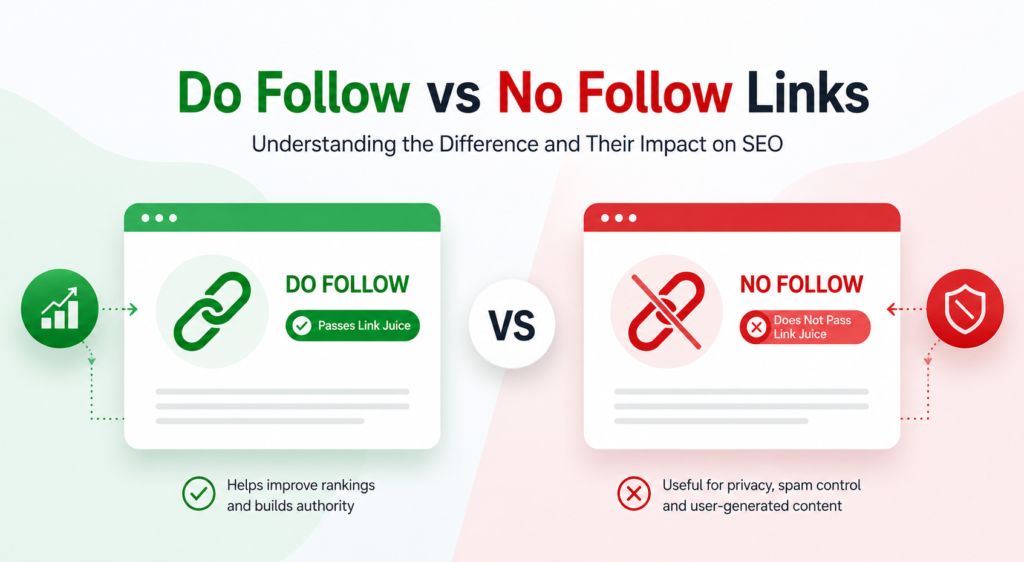
Backlinks are one of the most powerful ranking signals in SEO. When another website links to yours, it acts as a vote of confidence — telling search engines that your content is credible and worth showing to users. But here’s something many marketers overlook: not all backlinks carry the same weight.
Understanding the difference between DoFollow and NoFollow links is essential for anyone serious about building a strong organic presence. These two link types determine whether a backlink actually passes ranking power to your site — or simply exists as a reference without direct SEO impact.
In this guide, we’ll break down exactly what each type means, how search engines treat them, and how to use both strategically in your SEO campaigns.
Quick Stat
According to Backlinko’s analysis of over one billion pages, the number one result in Google search has, on average, 3.8× more backlinks than pages ranking in positions two through ten — highlighting just how critical a strong backlink profile is for SEO.
What are DoFollow links?
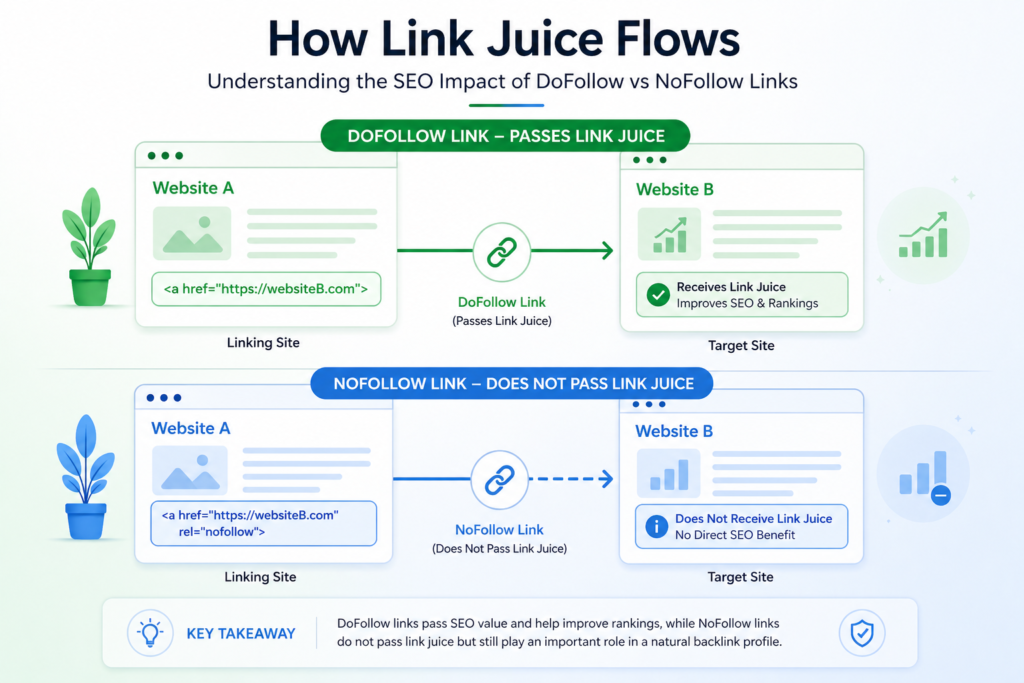
A DoFollow link is a standard hyperlink that instructs search engine crawlers to follow it and pass “link equity” — commonly called link juice — from the source page to the destination. This transferred authority directly contributes to how well the linked page ranks in search results.
DoFollow is the default behavior of any hyperlink. You don’t need to add any special attribute — a plain anchor tag is already DoFollow:
<a href=”https://yourwebsite.com”>Anchor text here</a>
When a high-authority website links to your content with a DoFollow link, it’s essentially vouching for you — and passing some of its own domain authority to your page. This is why earning DoFollow backlinks from reputable, relevant sites is at the heart of most link-building strategies.
What are NoFollow links?
A NoFollow link includes a rel="nofollow" attribute that signals search engines to not follow the link or pass any ranking credit. Google introduced this attribute in 2005 specifically to reduce link spam in blog comments and user-generated content.
<a href=”https://yourwebsite.com” rel=”nofollow”>Anchor text here</a>
In 2019, Google expanded the NoFollow ecosystem with two additional, more specific attributes:
rel=”nofollow”rel=”sponsored”rel=”ugc”
- rel=”nofollow” — General purpose. Used when you don’t want to editorially endorse a link.
- rel=”sponsored” — Required by Google for any paid, affiliate, or sponsored link placement.
- rel=”ugc” — Stands for user-generated content. Applied to links in comments, forum posts, or community discussions.
Since 2019, Google treats all three as “hints” rather than hard directives — meaning it may still choose to follow or credit these links depending on the context and content quality.
DoFollow and NoFollow Links: Key Differences Every SEO Should Know
| Feature | DoFollow | NoFollow |
|---|---|---|
| Passes link equity | Yes | No (generally) |
| Default link type | Yes | No — needs rel attribute |
| Crawled by Google | Yes | Possibly (as a hint) |
| Improves domain authority | Directly | Indirectly / minimal |
| Drives referral traffic | Yes | Yes |
| Required for paid links | Not permitted | Yes (rel=”sponsored”) |
| Common on social media | Rarely | Yes — almost always |
| Penalty risk if misused | Yes, if manipulated | Low |
SEO impact of DoFollow and NoFollow links
How search engines treat each type
Search engines don’t treat all DoFollow and NoFollow links the same way. Google’s crawler freely follows DoFollow links to discover new pages and factor them into PageRank — so every DoFollow backlink from a relevant, authoritative site directly strengthens your domain’s ranking power. NoFollow links tell a different story.
Historically excluded from PageRank calculations, they got a significant upgrade in 2019 when Google reclassified them from a hard rule to a “hint” — which means Google can now choose to index and credit NoFollow links whenever the content context makes it worthwhile.
The role of a mixed backlink profile
Here’s what separates experienced SEOs from beginners: a natural backlink profile always contains both types. The real secret to mastering DoFollow and NoFollow links is balance — if your site has nothing but DoFollow links — especially from similar-looking guest posts — Google’s algorithm may flag it as artificially manufactured. A realistic mix of editorial DoFollow links, social NoFollow mentions, and community UGC links tells a far more believable story of organic growth.
DoFollow
Builds domain authority directly. Best earned through editorial mentions, guest content, and resource pages from reputable sites.
NoFollow
Supports brand visibility and referral traffic. Common on social platforms, press coverage, forums, and community sites.
When to use each link type
Use DoFollow links for:
- Guest posts — In-content author links within articles on reputable industry publications
- Editorial citations — When journalists or bloggers link to your research or data organically
- Resource pages — Curated directories that genuinely recommend your content
- Internal linking — Connecting your own pages to distribute equity across your site
Use NoFollow links for:
- Blog comments — Most CMS platforms automatically apply NoFollow to comment links
- Paid or sponsored content — Google requires
rel="sponsored"on all paid placements - Forum and Q&A links — Reddit, Quora, and most community platforms NoFollow all outbound links
- Social media profiles — Facebook, LinkedIn, Twitter/X all apply NoFollow to external links by default
- Untrusted or unverified sources — Any link to content you cannot fully vouch for
Best practices for link building
Build a natural backlink profile
Aim for a mix that reflects authentic growth — editorial DoFollow links, NoFollow social and press mentions, and UGC links from community discussions. Understanding the balance between DoFollow and NoFollow links is key; there is no fixed ideal ratio, but what matters most is that your profile looks genuinely earned, not manufactured.
Prioritize quality over quantity
One DoFollow link from a trusted, high-traffic publication in your niche outweighs dozens of links from low-quality directories. Focus your outreach on sites your target audience actually reads and trusts.
Always tag paid links correctly
Failing to add rel="sponsored" to paid placements violates Google’s Webmaster Guidelines and can trigger a manual penalty. This rule applies to affiliate links too — not just traditional sponsored posts.
Use internal DoFollow links strategically
Your own pages can pass authority to each other. Internal linking guides search engine crawlers to your most important content and distributes ranking power across your domain — entirely within your control and at zero cost.
DoFollow and NoFollow Links: Common Mistakes That Hurt Your SEO
Ignoring NoFollow links entirely
Many marketers treat NoFollow links as worthless. They still drive real referral traffic, support brand awareness, and contribute to a natural-looking link profile — all of which matter for long-term SEO.
Building only DoFollow guest post links
A profile made up almost entirely of DoFollow guest post links looks artificial. Diversify your sources, link types, and anchor text to avoid algorithmic red flags.
Buying DoFollow links without proper tagging
Paid DoFollow links that aren’t marked as sponsored directly violate Google’s policies. The short-term ranking boost is never worth the penalty risk.
Adding NoFollow to all outbound links on your site
This signals to Google that you don’t trust your own content choices, which can appear manipulative. Only NoFollow links you genuinely don’t endorse.
Quick Stat
A study by Ahrefs found that 66.31% of pages have zero backlinks pointing to them — meaning the majority of content on the web gets no link equity at all. Pages with even a handful of quality DoFollow links have a significant competitive advantage.
Quick Stat
Research shows that NoFollow links make up over 50% of the average website’s backlink profile — confirming that a healthy, natural link portfolio always includes both DoFollow and NoFollow sources working together.
Frequently asked questions
Do NoFollow links have any SEO value?
Yes — indirectly. NoFollow links drive referral traffic, increase brand visibility, and support a natural backlink profile. Since 2019, Google also treats them as hints, meaning some may still influence rankings in certain contexts.
How do I check if a link is DoFollow or NoFollow?
Right-click any link in your browser, select “Inspect Element,” and look for rel="nofollow" in the anchor tag. If it’s absent, the link is DoFollow. This is the simplest way to manually distinguish DoFollow and NoFollow links. SEO tools like Ahrefs, SEMrush, or the free MozBar extension can also identify link types at scale across your entire backlink profile.
What’s the difference between rel=”nofollow”, rel=”sponsored”, and rel=”ugc”?
All three tell Google not to pass PageRank, but serve different purposes. nofollow is general purpose. sponsored signals a paid or affiliate relationship. ugc marks links in user-submitted content like comments or forum posts. You can also combine them — rel="nofollow ugc" is perfectly valid.
Is there an ideal DoFollow to NoFollow ratio?
There is no fixed benchmark. Most established websites naturally accumulate more NoFollow links from social media, press, and forums than DoFollow editorial links. Focus on earning high-quality DoFollow links through great content and outreach — a genuinely earned profile will reflect a healthy ratio automatically.
Conclusion
The discussion around DoFollow and NoFollow links often oversimplifies what is genuinely a nuanced topic. DoFollow links are the backbone of off-page SEO — they directly signal authority and move rankings. NoFollow links support brand visibility, referral traffic, and the kind of profile diversity that makes your growth look credible to search engines.
The strongest SEO strategies don’t choose between the two. They understand where each type naturally appears, earn both intentionally, and build a backlink profile that reflects real authority across the web. Focus on content worth linking to — and the right mix will follow.
Blog created and submitted by Deeksha Sharma
